No, I'm not going to write cliches about how math makes you analytic, clever, etc... No no, instead I am going to describe a phenomenon that happens to me every now and then; I have maybe already told it to some of you.
Here is the phenomenon: You are trying to solve a ("real life") situation or make a decision. Suddenly, your subconsciousness comes in, shows you an "image" and "suggests" a solution.
As a (stupid) example: You want to go to a city and consider whether to go by bus or by bike. Suddenly, you "see" the bus schedule together with a coming-out-of-nothing feeling: "You stupid, look at the schedule! Sure you should go by bus."
In this particular case, the above mentioned "see" meant literally having the picture in your head (such as if you recall someone's face), but sometimes the "image" is something more abstract (but it still "feels" like a real image).
Now, why do I find this special? Of course I am used to that my subconsciousness influences my decisions. But it usually does so in a subtle way - by coloring my feelings and whispering things like "good idea", "strange", "bad idea". But in the above situation, the subconsciousness just breaks into my thoughts and starts shouting.
Why do I think my Math studies have been involved? The first reason is that I first started experiencing this when I was in my second year of Math studies. The second reason is that it happens sometimes (when I am lucky) when solving mathematical problems - you try to prove something and suddenly, out-of-nothing you just know which formulas you have to write down. Actually, the phenomenon probably happened to me for the first time when working on math. However, when working on math, it didn't feel strange (doing math is a weird and obscure business anyway...) - but it does feel strange in the "real life".
I remember talking about it twice with Palo (it seems such a long time ago now...). It seems that he experienced something like that as well, his interpretation was different though (it was not subconsciousness for him).
What do you think about it, dear readers? Do you experience something like this as well?
Showing posts with label dark formulas. Show all posts
Showing posts with label dark formulas. Show all posts

23.8.11
Referee
I've received a mathematical article for refereeing, for a journal!
Sure, some people would say I shouldn't get too excited about that...But still, for the first time,...just seems cool :-)
Sure, some people would say I shouldn't get too excited about that...But still, for the first time,...just seems cool :-)
7.6.10
AAA80
I got an opportunity (thanks to my advisor) to attend a real conference in Mathematics - presenting the results of my Bachelor's thesis. Following, just a few random thoughts and remarks of mine:
It took place in Bedlewo, Poland - my first ('serious') visit to Poland. We lived in a castle and a building nearby and were wonderfully cared for.
I used almost all languages I knew (Czech, English, Spanish, French, Russian), except for Dutch and Chinese. Actually, I met a Dutch person and I talked to him, yet I wanted to get information from him, and as he was rather busy, I preferred getting information over practicing the language.
I met mathematicians, whose articles/books I'd had read before (so I consider them as nearly legends - oh come on, how many (little) books and articles has a bachelor read?) - Jonathan Smith, Rudiger Goebel, Anna Romanowska
A conversation:
Hmmm, but what does it mean, "geometric arguments", which areas of Mathematics does it encompass?? In what I have met so far in my life - the subjects: (Real and Complex) analysis, Topology, Differential geometry and Analysis on manifolds were full of such, while subjects encompassing Algebra and Logic mostly missed them (but also Functional analysis!!); Lie group theory was a mix. But now - does this say anything about the (mathematical) "real life"???
The Princeton Companion to Mathematics sort of divides mathematicians into geometers, analysts and algebraists. Distinction between algebraists and analysts being (succintly and imprecisely :-P ): "algebraists like equalities and analysts like inequalities". Do I really "prefer equalities", or is that just because of the plentitude of geometric arguments in early Analysis courses (together with the fact, that people in our Algebra department seemed more human-like than those at our Analysis department), that I consider myself to be an algebraist nowadays??
Being clever is not too appreciated (after all, every person doing Mathematics is; usually more then I am). What is appreciated, very appreciated - dedication, being hard working, passion and curiosity. This probably holds (as of my experience so far) in many other areas in life.
I don't want to end up doing research just for the sake of research (i.e. not interesting to anyone else, with almost no prospect of being interesting to anyone else even in future) - just a path too easy to follow in Mathematics (judging from what I saw and - even more - from the opinions of people who can probably be judged as "quality mathematicians"). But on the other hand (judging from what I saw and from the opinions of people who can probably be judged as "quality mathematicians")...there seems to be also so so much of the interesting Mathematics!
Giving talks, making presentations: slogans, pictures, examples...and motivation, if there is any.
"One has to have a lot of examples to develop the intuition."
It took place in Bedlewo, Poland - my first ('serious') visit to Poland. We lived in a castle and a building nearby and were wonderfully cared for.
I used almost all languages I knew (Czech, English, Spanish, French, Russian), except for Dutch and Chinese. Actually, I met a Dutch person and I talked to him, yet I wanted to get information from him, and as he was rather busy, I preferred getting information over practicing the language.
I met mathematicians, whose articles/books I'd had read before (so I consider them as nearly legends - oh come on, how many (little) books and articles has a bachelor read?) - Jonathan Smith, Rudiger Goebel, Anna Romanowska
A conversation:
"Is he good?"I was asked several times, what Mathematics I want to do in future. A lot of questions makes one think about it thoroughly. What I have thought out so far: I don't like geometric arguments (and am not good at making them). I'm good at abstracting (yes, this part is still rather vague...).
"Yes."
"Extremely good?"
"I don't know, he is not my student."
(To me:) "Unless you are extremely good, don't do universal algebra. It's too isolated... Maybe try combinatorics.
Hmmm, but what does it mean, "geometric arguments", which areas of Mathematics does it encompass?? In what I have met so far in my life - the subjects: (Real and Complex) analysis, Topology, Differential geometry and Analysis on manifolds were full of such, while subjects encompassing Algebra and Logic mostly missed them (but also Functional analysis!!); Lie group theory was a mix. But now - does this say anything about the (mathematical) "real life"???
The Princeton Companion to Mathematics sort of divides mathematicians into geometers, analysts and algebraists. Distinction between algebraists and analysts being (succintly and imprecisely :-P ): "algebraists like equalities and analysts like inequalities". Do I really "prefer equalities", or is that just because of the plentitude of geometric arguments in early Analysis courses (together with the fact, that people in our Algebra department seemed more human-like than those at our Analysis department), that I consider myself to be an algebraist nowadays??
Being clever is not too appreciated (after all, every person doing Mathematics is; usually more then I am). What is appreciated, very appreciated - dedication, being hard working, passion and curiosity. This probably holds (as of my experience so far) in many other areas in life.
I don't want to end up doing research just for the sake of research (i.e. not interesting to anyone else, with almost no prospect of being interesting to anyone else even in future) - just a path too easy to follow in Mathematics (judging from what I saw and - even more - from the opinions of people who can probably be judged as "quality mathematicians"). But on the other hand (judging from what I saw and from the opinions of people who can probably be judged as "quality mathematicians")...there seems to be also so so much of the interesting Mathematics!
Giving talks, making presentations: slogans, pictures, examples...and motivation, if there is any.
"One has to have a lot of examples to develop the intuition."
29.5.10
SVOC 2010
I attended SVOC 2010 in Ostrava (SVOC stands for "Soutěž studentů vysokých škol ve vědecké odborné činnosti v matematice a informatice" - a competition of university students in scientific activities in Mathematics and Computer Science???).
I liked it - there was a lot of opportunities to talk with fellow competitors about their work and I learned about a lot of interesting topics. Apart from the presentations in my section (algebra, topology, geometry) , I managed to see a few presentations about Analysis and Applied Mathematics - interesting to compare the overall environment in the respective sections (I don't know how to articulate it, yet I felt it differed somewhat).
I also somehow managed to win the joint first place. Wow. I just can't understand how it might happen. Perhaps I was the most enthusiast one...
24.7.08
Venn diagrams
Just found a rather interesting page about Venn diagrams.
You may not be that fond about the graph theory remarks (though, it's interesting to read about the searching for the diagrams using exhaustive search by computers..),
but you'll definitely enjoy the p i c t u r e s :)
Here, they give out the definition.
You may not be that fond about the graph theory remarks (though, it's interesting to read about the searching for the diagrams using exhaustive search by computers..),
but you'll definitely enjoy the p i c t u r e s :)


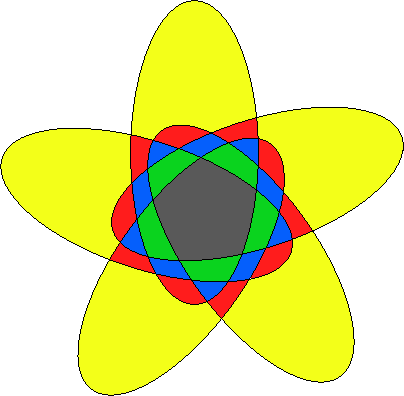


Here, they give out the definition.
29.2.08
Heine-Borel theorem
For those who are interested in one fun "proof" of what we do in the school.
Heine-Borel theorem on Youtube.
What does it state?
Heine-Borel theorem on Youtube.
What does it state?
Heine-Borel theorem: Let there be given an interval (a, b) and a set of intervals I each the members of which is in (a, b). Moreover, let I possess the properties:
(i) Every point of (a, b), other than a or b, lies inside, i.e., 'in and not at an end of', at least one interval of I;
(ii) a is the left hand and b the right hand end point of at least one interval of I.
Then it is possible to choose a finite number of intervals from the set I which form a set of intervals with the properties (i) and (ii).
Note that the set of intervals may have well been infinite and still, you can pick just a finite number while retaining all the "information".
Subscribe to:
Posts (Atom)